Unforseen Side Effects of an Expensive Education

Once upon a time, not so very long ago, I had the opportunity to spend 6 years of my life pursuing advanced degrees in English. This is an opportunity for which I am grateful--and for which I am still making monthly payments. Upon the completion of said degrees, I chose to make a career shift. Now I stay home with my children. Despite the inherent challenges, I love it. However, early on I encountered an unexpected problem: while reading books to my young daughter I had to repeatedly suppress the urge to make edits to the texts with a Sharpie. I am grateful for my daughter's love of books, but after being nearly driven to distraction several times by the repeated reading of books I couldn't stand, I started making lists. I noted various authors and titles that I could read over and over without being overcome with the urge to poke out my eyes. Now, with this blog, I endeavor to share these eye-poke-less (in my opinion) books with my other Mom and Dad friends. Hopefully this will help to make story time more enjoyable for everyone. Perhaps it will even save you from finding yourself spinning a web of white lies in order to cover up the fact that you hid that one book you couldn't stand to read even one more time under the couch...

Wednesday, April 13, 2011

Leaves! Leaves! Leaves!

This book isn't necessarily a stunning literary specimen, but it provided a great background for a project I did with my daughter. In this story, Buddy and his mom make observations about trees in each of the four seasons. It explains how and why trees change, and helps children notice what is going on around them. After reading this book, we made a "Four Seasons Tree Book." Here's what we did:

I printed four copies of a leaf-less tree, pictures of spring buds opening, pictures of green summer leaves, pictures of autumn foliage, and pictures of closed winter buds. I also printed pictures of spring grass and mud, summer grass, leaf-covered autumn grass, and ground covered in snow. I made a cover that said "My Four Seasons Tree Book" and I also printed one page that had the words 'spring', 'summer', 'fall', and 'winter' on it. All of these things I printed on card stock. After printing, I cut out the pictures of leaves in different seasons, and I cut up the different ground coverings into small pieces. I left the page with the names of seasons on it whole. I used a three-hole-punch on each of the four tree pages and the cover. If you want to try this project, I made the document I used for all of this printing and cutting into a PDF and here it is. Look at me, being all fancy and stuff. (It is quite possible, by the way, that my nifty little PDF violates some copyright law or other with the pictures I copied from the internet. SO, if I've offended you or stolen your stuff, let me know and I'll fix it.)

Now...where were we?

I brought these prepared materials to my daughter and we completed the following steps over two or three days:

We read Leaves! Leaves! Leaves! and talked about how trees are different in each season. We started with winter. My daughter took one of the tree pages and colored the trunk of the tree and its branches. I presented a tray with all the different leaf pictures on it. Based on what we learned in the book, she was able to identify which leaf pictures belonged on the winter tree. She chose the right ones and we glued them on. We did the same thing with a tray filled with the different ground coverings. Then I presented the page with the names of each of the four seasons. By sounding out the words she was able to discern which one said 'Winter.' We had previously been working on her scissor skills, so I had drawn dashed boxes around each word and she was able to cut out the word 'Winter,' which we then glued onto the bottom of the page she had just completed.

We repeated each of these steps for each of the three remaining seasons. I was pleased with the variety of skills practiced in this project, and the repetition of these skills with the completion of each page was also helpful. I also encouraged her to color the sky and draw in any surroundings (birds, squirrels, flowers...) she wanted to include in her picture, but she never has been big on coloring so in most cases she courteously abstained.

For the finishing touches, my daughter decorated the cover of the book and we tied it all together with some yarn. She was thrilled to have made her own book and she was very proud to "read" it to her dad when he got home.

For a more in-depth exploration of trees, I would recommend A Tree Is Growing. There is a simpler body of main text with all sorts of informative insets and side bars for the more curious (and more patient) children. There are plenty of interesting facts to educate and amuse both reader and child. A great follow-up to this activity!

Friday, February 25, 2011

birdsongs

By Betsy Franco and Steve Jenkins

I have a very active and precocious 4 year-old. If she is left with too much unstructured time, mayhem ensues. In order to combat this, I have taken to planning various activities at the start of the week. I also have a very active 15 month-old, so I have to plan these things and gather the supplies beforehand so I can just whip them out at strategic intervals in order to ward off chaos and destruction. Being a book nerd, I like to have books to supplement and support these activities. One of the things we did this week was to watch birds at our bird feeder (a favorite activity, as is evidenced by the quantity of face and finger prints on the window by the feeder...) and look up each bird in an old book I got from my parents. My 15 month-old pointed to each bird and shouted "quack, quack, quack!" and my 4 year-old got so interested in looking things up that she eventually abandoned the birds and looked through the entire Reader's Digest Guide to North American Wildlife (which is actually pretty cool). In both cases, I deem it a success.
I've read birdsongs to my oldest several times before and thought of it again as I was preparing the above activity. I love Jenkins's illustrations (I wonder if I am supposed to use a different word for them since they are made out of paper instead of drawn or painted?) and have read many of his books to my daughter. I am continually astounded by the intricacy and variations achieved by laying little bits of paper on top of one another. The story is great too--it exposes children to different birds, what they look like, and their calls (this part also provides a fun opportunity for some spirited reading aloud!). It also involves counting and ties it all together with a simple story of a day passing. In the back of the book there are some great facts about each species of bird mentioned. My daughter is always asking me if we can "check up on the computer" about various random topics, and this book provides a great starting point for such explorations. It was also a great supplement to our little birdwatching endeavor.

It's Snowing!

By Olivier Dunrea

This is another story to celebrate snow. It's text is shorter and simpler than some, making it perfect for younger children. The illustrations are lovely, providing plenty to amuse older children and adults!
A mom rocks her baby by the fire on a cold night. When she notices it is snowing, she seizes the moment and brings baby outside for some adventure. The story ends with them by the fire again--warm and toasty--but mom has more of a smile than she did in the opening illustration.
Simple. Charming. Worth reading.

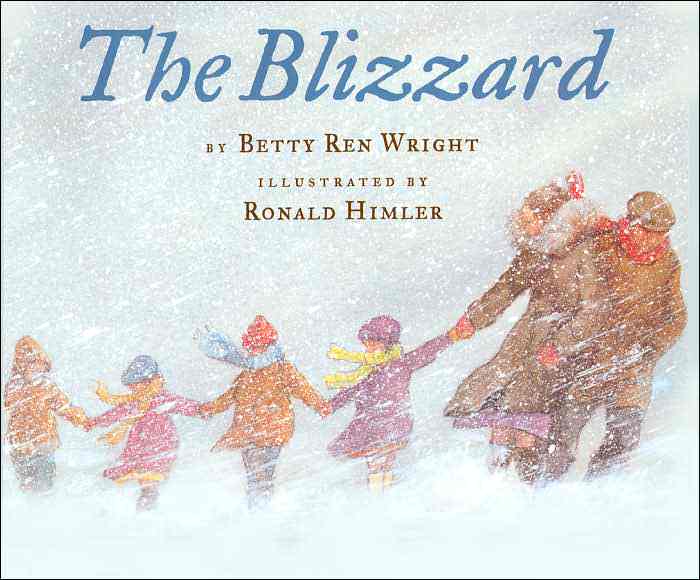
The Blizzard

By Betty Ren Wright and Ronald Himler

After Christmas, there is still a lot of winter left where we live. I try to embrace each season and enjoy it while it lasts. I find reading season-appropriate books with my children helps me remember to do that (and hopefully it will help them to form a similar attitude!). I enjoy this book because it begins with one of the downfalls of a snowy winter--Billy's December birthday party is interfered with by a snowstorm. His cousins can't come because of the bad weather. The storm turns to Billy's advantage, however, as the snow falls so thickly that all of the children in the one-room schoolhouse and their teacher are forced to spend the night at Billy's house. The weather is too bad for them to walk to their own homes which are further away. Billy's birthday is better even than he had hoped as his parents open their home and offer hospitality to the stranded students.
This is a cozy Little House on the Prairie-esque book to read on a stormy day. Himler's illustrations of falling snow are excellent (the rest are pretty mediocre, but they don't detract from the text) The story teaches kindness--Billy shares his birthday cookie with his friend--and hospitality--Billy's mom is not even a little bit annoyed to find her house full of kids, but sets about immediately making provisions for feeding and housing them all. The unexpected guests add to the family's enjoyment and content rather than seeming a burden and a stress, thus illustrating very well the paradox "whosoever will save his life shall lose it: and whosoever will lose his life for my sake will find it."

Bear's First Christmas

By Robert Kinerk and Jim LaMarche

We have another Christmas tradition at our house (I started this after hearing a story on NPR about a family who did something similar)--We have a box of Christmas books that we get out every year just after Thanksgiving. All other times of year, these books are packed away in order to keep them special and fresh. I try to add a few new ones each year (usually during post-Christmas sales at bookstores...). We read a few (or a lot) of these books each day between Thanksgiving and New Year's Day. It is a calm and cozy way to enjoy the season, and a great way to help kids form positive associations with reading.
I borrowed this book from the library last year and liked it so much we borrowed it again this year. (Hurray for libraries, by the way!) I love the illustrations--well, most of them. One of my two gripes with the book is that I think LaMarche goes to too much trouble in a few instances to make it look like the bear is smiling. What I like best about the other illustrations in the book is that the animals actually look like animals (aside from the bear's silly smile), and yet somehow still convey feeling. I also really like the font--I don't know if the artist had any influence there, but it goes nicely with the illustrations. My other annoyance with the story is that one of the characters--a small tree--is used rather heavy-handedly in a metaphor that strikes me as a bit trite...but I forgive this (and the bear's smiles) in light of the books many other strengths.
The story teaches the crux of Christ's teachings--"love one another." A bear is awoken from hibernation in mid-winter by a sound. He goes of in search of its source and is able to render many acts of service for his fellow creatures along the way. The animals then continue together until they discover a warm, lighted house wherein a family is singing around a Christmas tree. In an interesting nod to reality, the animals do not exactly understand what they are seeing. The house is described as "A lair or a burrow all lit by a glow." But, while the beasts do not comprehend all they observe, they do perceive its import--perhaps an excellent metaphor for our own experience in this life and in our search for meaning and truth?
All together, this is a charming book--very inviting illustrations, a somewhat fresh take on Christmas, and a very well-wrought rhyme and meter which flows very nicely and sets a fine tone for the story.

Mortimer's Christmas Manger

By Karma Wilson and Jane Chapman

It's rather late for Christmas books, but it's always good to plan for next year. I also read a neat idea somewhere--to have Christmas in February (or March...). Choose a day in February, play Christmas music, drag out your nativity set, read Christmas stories (like this one!), have a simplified Christmas dinner, and give each member of the family a small gift. Top it all off by reading the accounts of Christ's birth in the scriptures. This will create a bright, warm spot in an otherwise cold and dreary month. It will allow you to appreciate the spirit of Christmas without all the crazy schedule business usually attached to December, and it will help to illustrate how the real gift of Christmas is wonderful every day and every time of year, not just at Christmastime.
This year I borrowed Mortimer's Christmas Manger from the library, and we loved it. It is a cute story about a mouse named Mortimer who is looking for a cozy home. He finds what looks like the perfect thing on a table near the family's Christmas tree. Unfortunately, there are a bunch of statues in the way. Each night he drags them out and each day the family puts them back until Mortimer overhears them reading the story of Christ's birth in Luke. Then, he looks at the statue whose bed he had been stealing each night and realized, "You aren't just any statue. You are a statue of Jesus." This story teaches in a simple but moving way that we can each find ways of making room for Christ in our lives. Mortimer gives up his new found home in order for baby Jesus to have a place to sleep--and then he spies the family's gingerbread house. What more could a mouse want?
Karma Wilson and Jane Chapman also make a great team in Bear Snores On and the other books in that series. I recommend those as well. Chapman's illustrations are whimsical but expressive and interesting. There are some great details--for instance, the illustrations of the family's home don't look like they came out of a Pottery Barn catalog, they look like real people live there. Couch cushions are crooked, throw pillows are squenched, toys are on the floor, an abandoned cup is on the table, and there are stray pine needles and Christmas ornaments hiding in various nooks and crannies. The mom in the family also has some fantastic furry slippers.

Wednesday, November 17, 2010

Franklin's Thanksgiving


By Paulette Bourgeois and Brenda Clark

A seasonal favorite, this story is helpful for children whose extended family does not live close by, or for those whose usual traditions are changing. Franklin deals with the disappointment of learning that his grandparents will not join them for Thanksgiving, and then he and his family discover that new traditions can be just as enjoyable as old ones and that friends and neighbors can be family too. The illustrations in the Franklin books are so full that they give parents something new to look at even after they have memorized the story from multiple readings.

One More Sheep


By Mij Kelly and Russell Ayto

With a witty rhyme this book tells the story of a shepherd who has trouble counting his sheep. It seems sheep counting puts him to sleep. When a wolf in sheep's clothing tries to capitalize on the shepherd's narcoleptic tendencies, the sheep are forced to extreme measures. Aside from the amusing puns, this book holds interest for both reader and audience and provides an entertaining counting practice for the young ones.

That Stripey Cat


By Norene Smiley and Tara Anderson

This book taught my daughter to say the word "persnickety" at age 18 months. That's really why I like it. Aside from that, it does have the repetitive story line that young children enjoy and it teaches about relationships.

Monday, September 20, 2010

Boo and Baa Have Company


The Boo and Baa books are quirky little tales of the adventures of two sheep. Boo and Baa are always getting themselves into scrapes of one kind or another and inexpertly getting themselves back out again. The text is translated from, I believe, Swedish. The translation seems to be a bit clunky, but this amuses me even more--the fact that they call a "board" a "plank" and say things like "now it dares go onto the plank!" all contribute to the wonky humor of the story. I also enjoy details in the illustrations which show the book is clearly not American (the kitchen, the presence of bubbly water, and the sandwiches prepared in this story are a dead giveaway on that point)--a refreshing change. Kids may miss out on or not care about these details, but they will enjoy this charming little seasonal story. Living in a place with four seasons, I always enjoy reading seasonal books with my children as it helps them to notice and appreciate the changes going on around them. Having grown up in New England, I will continue to read seasonal stories with my children even if we move at some point to a different climate. I'll want them to know what they're missing! :) I also think that an awareness of the changing times in a year helps to break up time and give reference points to small children--to whom even one rainy afternoon can seem like an eternity!

Blueberries for Sal


This is an excellent old classic which everyone has probably heard of. (Yes, I did just end a sentence with a preposition.) In this story, the ordinary adventure of blueberry picking undergoes a twist when a couple of bears are involved. Through patterns and repetition, children can see Sal solve the problem of suddenly finding herself with the wrong mother (something probably experienced by all children at one time or another in the supermarket...). As the repetitious reader out loud, I enjoy the details in this book's illustrations. I am amused to see Sal's mother traipsing up a hill through the blueberry bushes in a long skirt with her hair tidily done (thank goodness those days are over!) and I especially like the illustration on the hardcover's endpapers of the vintage kitchen with its wood stove and the old school canning jars (I'm also glad these technologies have been improved...). The car drawn at the beginning help to complete the visage of 1948, the year of the book's original publication--at least the quaint, picturesque parts. I suppose, though, it is difficult to enjoy the picturesque-ness without remembering the alarming inequalities and discrimination of the time, not to mention the ever-present political turmoil... . It is interesting to see the ways in which the media of a given time treats--or fails to treat--the ills of the contemporary society. Here we have a cute little story about mundane every-day things written in a year that sees the mistreatment of anyone not white and male, the Berlin Blockade, and the ongoing restructuring of Germany after WW II. Even children's books are not free from cultural context and can help one to better understand a time period. That was probably all very boring for normal people. Sorry. Even if you're not interested in things like cultural context, this is an enjoyable little time capsule with a timeless appeal.

Sunday, June 27, 2010

How to Clean a Hippopotamus


Steve Jenkins and Robin Page

So how DO you clean a hippopotamus? It turns out that turtles make a snack of all the yucky stuff that collects on a hippo. Delicious. There are all sorts of other fascinating (if slightly icky at times) facts in this great book. The cut paper illustrations are surprisingly detailed and realistic. Another great nonfiction book from Jenkins and Page. Highly recommended!

Wednesday, May 12, 2010

Can't You Sleep, Little Bear?

By Martin Waddell, Illustrated by Barbara Firth

This book has won all sorts of awards, but it is actually my least favorite member of the Big Bear, Little Bear series. It is still quite good and I like it, I just like the others in the series much better. This one, after the 3rd or 4th reading, starts to get on my nerves a bit. Maybe it's because similar things have happened at our house... Little Bear is trying here to get over his fear of the dark. Big Bear, as usual, helps him out. I would NOT recommend reading this to your child if it has not yet occurred to him or her to be afraid of the dark--no need to go putting ideas in little heads before their time!

Let's Go Home, Little Bear

By Martin Waddell, Illustrated by Barbara Firth

This is a good book to read with your little one on a snowy day. Big Bear and Little Bear are out for a wintery walk in the woods when little bear hears something... Sometimes things that are really quite ordinary can seem rather scary out of context. Big Bear helps to assuage Little Bear's fears and the end up cozily in the Bear Chair at the end of the day.

You and Me, Little Bear

By Martin Waddell, Illustrated by Barbara Firth

I can't decide if this or Good Job, Little Bear is my favorite in the series. Here we see Big Bear balancing the need to do chores (and sleep...) with Little Bear's need for attention. Little Bear also learns to play well by himself while he waits his turn. Big Bear and Little Bear do a good job of showing a loving, nurturing relationship without being sappy or trite. Too often kids' books go over the top when trying to show love. In this series, Waddell finds just the right pitch. Firth's bear illustrations mirror this balance as Big Bear and Little Bear are endearing and manage to show emotion in their expressions without being the completely unrealistic, puffy looking things one often finds in children's books about bears.

Good Job, Little Bear

By Martin Waddell, Illustrated by Barbara Firth

I absolutely love this series. Waddell has written many excellent children's books, but the Big Bear and Little Bear stories are my favorite. They each depict real concerns of small children--this one addresses the urge for independence, balanced with the need to feel safe and loved--and they model some really excellent parenting. The best thing of all, though, is that this excellent parenting is performed by a Dad bear for a change. It is certainly good for children to see loving Moms in their stories, but Dads often get short shrift. Kudos to Martin Waddell and Big Bear for giving the male parental unit part of his share of appreciation.

Hairdo!

By Ruth Freeman Swain

My 3-year-old loves nonfiction. From reading these sorts of books, she has an amazing number of random facts stored in her little head, which she brings out at interesting moments. This book is an engaging trot through the history of hair, filled with amusing (and sometimes icky--bugs, lard, etc.) facts and anecdotes. I learned as much from this book as my daughter did. I look forward to reading Freeman Swain's other books.

There Are Cats In This Book


By Viviane Schwarz

This interactive book is lots of fun for kids and parents--maybe not the best idea for grabby babies as there are lots of flips and flaps that could easily be torn off by eager chubby fingers--but very engaging for the slightly older child. The story starts on the front cover and doesn't end until you actually close the book. Each page has fun things to do with Moonpie, Tiny, and Andre, and I think the text is hilarious (I do have an odd sense of humor, though, so let me know what YOU think!). My favorite part is "mmm I feel fluffy!" You can even get knitting patterns for the characters: http://www.walker.co.uk/UserFiles/file/There%20are%20cats/catknitting%20small.pdf

The only problem with this book is that it is so much fun it will produce more laughs than yawns. Maybe it is more of a "good morning" book than a "good night" one.

Monday, April 12, 2010

Time For Bed

Mem Fox, Jane Dyer.

This is a great book to help establish that ever essential bedtime routine for even the smallest baby. The repetitive rhyming story and the soothing illustrations are a great way to signal to the little one that it is time to sleep. There is something cathartic, too, for a parent to read about the mundane daily acts of caring for a child. Perhaps it is that it helps one to reflect on the actual significance of the things that can seem so small...

I Met A Dinosaur


Jan Wahl & Chris Sheban.

Of all the dinosaur books I've had to read lately, this one is by far my favorite. First, I like the fact that the protagonist in the story is a girl. I don't want my daughter to feel like she can only like princesses and flowers so it's nice to see stories that depict girls who have a broader range of interest. I also enjoy the way famous paintings are suggested in the illustrations. I always appreciate it when authors and illustrators make an effort to amuse the parent as well as the child. There is also a little fact page in the back with some information on the dinosaurs mentioned in the story just to get in a little dose of science facts.